
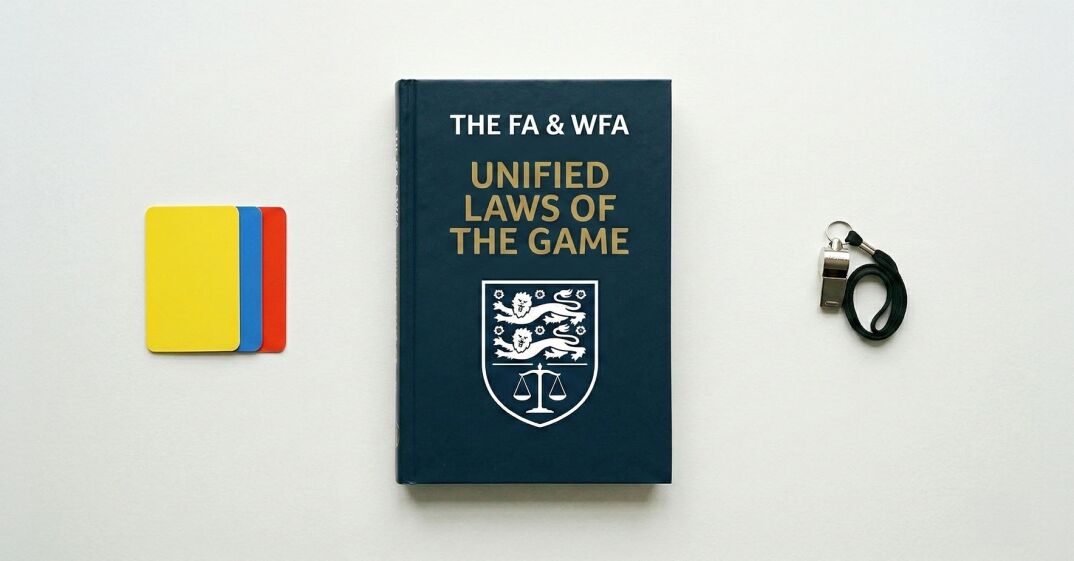
After over a decade of confusion, walking football in England will finally be played under a single set of rules from January 2027.
The FA and the Walking Football Association (WFA) published their unified Laws of the Game on Friday 13 November, putting an end to conflicts around corners, sin bins, penalties and many other points of difference.
When we compared the FA and WFA rules side by side earlier this year, we said we’d be glad to see that guide become obsolete. From January it will be.
In what we believe is the most comprehensive review of the changes online, here you’ll find the story of how we got to this point, a comparison between the new laws and what each code said before, and our thoughts on what the unified rulebook means for walking football going forward.
- Announced
- Friday 13 November 2026
- In force
- January 2027
- Applies to
- Walking football in England
- Governing body
- The FA, with the WFA as National Delivery Partner
- Survey backing
- 98% wanted one set of laws
- Reviewed
- Annually
How we got to one rulebook
The WFA was founded in 2016 and developed its own Laws of the Game with input from clubs and referees, separate to a later rulebook published by The FA itself.
Since then every walking football club, league and competition in England has had to choose which set of rules to enforce, often adding further tweaks of their own.
Initial conversations on a merging of the laws happened in 2019 with no success and it wasn’t until seven years later in February 2026 that talks resumed and a national survey was launched.
The results of the survey gave both associations a clear mandate to “get on with it” (our words, not theirs), with 98% of respondents agreeing that a unified set of rules was needed and 93% accepting that compromises would be necessary to get to them.
A few months later, in August 2026, The FA and WFA announced a formal partnership. The FA would be the governing body for walking football in England and the WFA a National Delivery Partner. The unified laws are the first major development of the venture.
Although nobody really wants to admit it, The FA was always going to win this battle. It’s the governing body for all football in England and it was only ever a matter of time until it wrested primary control from a third party.
A decade to one rulebook
The WFA is founded and writes its own laws in the absence of official FA guidance.
The FA releases its own walking football rulebook before significantly revising it a year later in 2018.
A first attempt to unify the two codes ends without a single rulebook.
The FA and WFA launch a joint survey on unification.
Partnership announced. The FA becomes the governing body and the WFA a National Delivery Partner.
The unified Laws of the Game are published.
The unified laws come into force.
The FA is committed to using the new laws in all of its own walking football competitions and recommends other organisers do the same.
A new Referee Development Panel will run online webinars for walking football referees before January and a new online referee course is due to launch in early 2027.
The two bodies will review the new laws every year.
The new unified walking football rules at a glance
The Summary of Changes published by The FA lists amendments to 11 of its current laws, with everything else carrying over unchanged. Here are the headlines:
Unified walking football laws: the key numbers
The table below compares all of the 2027 changes against the positions of the two current rulebooks. The last three rows are rules that haven’t changed from The FA’s version but will be new to anyone who has played under the WFA’s.
| Rule | Until now | From January 2027 |
|---|---|---|
| Team offence count | FA: penalty on a team’s 4th not-walking offence. WFA: no team count | Penalty on a team’s 6th walking or contact offence |
| Player offence count | FA: left to the referee under its caution categories. WFA: sin bin on a 3rd infringement | Blue card on a player’s 3rd walking or contact offence |
| Sin bin length | FA: 2 to 5 minutes, chosen by the competition. WFA: 10% of the match | 3, 4 or 5 minutes, fixed by match length |
| Goals from corners | FA: allowed. WFA: not allowed | Not allowed |
| Penalty spot | FA: 6.5m. WFA: 6m to 7m | 7m |
| Free kicks by the area | FA: 3m from the penalty area line | 3.5m from the penalty area line |
| Height limit | FA: crossbar height to 2m. WFA: 1.83m or crossbar height | Crossbar height to 2m, set by the competition |
| Keeper save pushes ball over height limit | FA: kick-in to the opposition. WFA: keeper keeps the ball | Kick-in to the opposition |
| Sideline restarts | FA: kick-in or roll-in. WFA: kick-in | Kick-in only |
| Goal clearances | FA: underarm throw or kick. WFA: underarm roll or kick | Kicked |
| Barriers | FA: ball stays in play off a barrier. WFA: ball dead on contact | Ball stays in play off a barrier |
| Definition of walking | FA: one foot always in contact with the ground. WFA: also required a straightened leading leg | One foot always in contact with the ground |
| Keeper’s time on the ball | FA: 6 seconds. WFA: no limit set | 6 seconds |
The rule changes in detail
1. Walking and contact offences share one count
Law 18 has been renamed Walking and Physical Contact with the two offences now combined in two running (literally) totals. One follows each player and the other follows each team.
Law 18: how the two counts work
Each playerWalking or contact
Active for the whole match and only resets once a player has served time in the sin bin.
Each teamWalking or contact
Resets after the penalty and at half-time in matches of 20 minutes or more.
| Rule | FA | WFA | Unified |
|---|---|---|---|
| What counts | Not walking | Infringements, counted per player | Not walking and physical contact |
| Player count | No fixed count | 3rd infringement = sin bin | 3rd offence = blue card |
| Team count | 4th offence = penalty | None | 6th offence = penalty |
The concept of a team count has always been unique to The FA whose rules awarded a penalty for a team’s fourth offence. In contrast, the WFA had no team count but sin-binned individual players on their own third infringements.
The new unified law takes both ideas and extends them further meaning that a push or a late challenge now moves a team closer towards a penalty in the same way running does.
The FA’s reasoning is that a combined count should be a stronger deterrent and make the game safer for all players. The move from four to six offences gives teams greater margin for error than the old FA rule and we believe a sensible balance has been struck.
2. Sin bins are fixed by match length
A blue card still means a spell off the pitch, but competitions no longer choose the length themselves. Law 12 now ties the length of time in a sin bin to the length of a match.
| Match length | Sin bin | Proportion of game |
|---|---|---|
| Under 20 minutes | 3 minutes | A quarter of a 12-minute game |
| 20 to 29 minutes | 4 minutes | A fifth of a 20-minute game |
| 30 minutes or more | 5 minutes | A sixth of a 30-minute game |
Any time left to serve at half-time carries over into the second half, with the same logic also applying to extra time. A player who’s still in the sin bin at the final whistle is allowed to take part in a penalty shoot-out.
Traditionally, the WFA set the sin bin length to 10% of the match. This resulted in a two-minute punishment in a 20-minute game which now doubles to four minutes!
3. No goals direct from corners or kick-offs
Law 17 now states that a goal can’t be scored directly from a corner. A goal only counts once a player other than the corner taker has deliberately played or touched the ball.
| Ball goes straight in | Restart |
|---|---|
| Corner, into the opponents’ goal | Goal clearance to the opponents |
| Corner, into the taker’s own goal | Corner kick to the opponents |
| Kick-off, into the opponents’ goal | Goal clearance to the opponents |
| Kick-off, into the taker’s own goal | Corner kick to the opponents |
| Free kick, into the opponents’ goal | Goal clearance to the opponents |
The FA’s original rules allowed goals direct from corners while the WFA’s rules didn’t. The unified laws follow the WFA’s approach. The same wording has been added to the kick-off law, where neither set of laws allowed a goal to be scored directly.
The phrase to watch is “deliberate play or touch”. The guidance notes included alongside the laws themselves confirm that a deliberate save by the goalkeeper counts. As such, a corner that a keeper pushes into their own net is a goal.
The laws even cover the unlikely (almost impossible) scenario where a corner or kick-off somehow ends up in the taker’s own goal. It’s hard to picture that happening at walking pace and with a limit to the ball’s height, but if it does, the opposition is awarded a corner.
Note that the term “Goal clearance” is used to describe a goal kick in walking football.
4. The penalty spot moves back to 7m
Law 1 moves the penalty spot (or the “Penalty Mark” as per the rules) from 6.5m to 7m from the middle of the goal line.
The FA’s reason for this is to stop the penalty taker ending up inside the penalty area when they follow through given that, technically, outfield players aren’t allowed to enter it.
The penalty area itself remains a 6m semi-circle.
Law 1: the penalty spot from January 2027
| Rule | FA | WFA | Unified |
|---|---|---|---|
| Penalty spot | 6.5m | 6m to 7m | 7m |
| Taker’s approach | Both feet on the ground, within 2m of the ball | Maximum 1m run-up | Both feet on the ground, within 2m of the ball |
| Feinting | Not once the approach is complete | A foul | Not once the approach is complete |
Law 14 also says that the taker must not feint to kick the ball once they’ve completed their approach. That was already how The FA’s rules worked making it a clarification and not a new restriction.
5. Free kicks by the area move out to 3.5m
When a goalkeeper commits an offence inside their own area, such as holding the ball for more than six seconds, the attacking team is awarded an indirect free kick.
As attackers can’t enter the area, the free kick is taken outside of it at a distance of 3.5m from the edge of the penalty area (it used to be 3m).
This change helps to prevent situations where a defender, who must remain 3m from the position of the free kick, is forced to stand directly on the penalty area line.
The extra half metre provides a meaningful legal space and reduces the chances of a defender illegally entering the area.
Law 13: free kicks by the penalty area
The same 3.5m distance covers every free kick given against a goalkeeper inside the area. That includes holding the ball for more than six seconds, touching it a second time after a goal clearance and sending it above the height limit when it’s under control.
6. The ball height rule gets clearer
| Who sends it too high | Restart |
|---|---|
| An outfield player | Indirect free kick from where the ball last touched that player |
| A keeper in control of the ball | Indirect free kick to the opposition, 3.5m from the edge of the penalty area |
| A keeper making a save or block | Kick-in to the opposition, level with where it happened |
Individual competitions remain free to set the maximum ball height limit somewhere between crossbar height and 2m, as they were under The FA’s original rules. The new wording clarifies where free kicks should be taken from when the limit is breached, and what happens when the ball goes too high off a goalkeeper.
Under the original WFA rules, a keeper usually kept the ball after saving it above head height, but now a save like that hands the opposition a kick-in.
7. Kick-ins only, plus goal clearances must be kicked
| Restart | FA | WFA | Unified |
|---|---|---|---|
| From the sideline | Kick-in or roll-in | Kick-in | Kick-in |
| Goal clearance | Underarm throw or kick | Underarm roll or kick | Kick |
Every mention of roll-ins has been removed from Law 15, with all sideline restarts reverting to kick-ins only. The FA’s reasoning is simply that roll-ins weren’t being used much.
Law 16 has had every mention of throwing removed and the summary also says all goal clearances should be kicked. The ball must be stationary and leave the penalty area or the clearance is retaken.
The laws don’t set out how a keeper has to release the ball after a save in open play, so ask your competition organiser or the referee if you’re unsure.
A keeper can still pick up a pass back from a team-mate. What they can’t do, however, is play a one-two. Once the keeper has passed the ball, it has to go through two team-mates or touch an opponent before the keeper can have it back. That applies to their feet as well as their hands.
8. Dropped balls and equipment
Two laws have been made consistent with other forms of football.
Firstly, for dropped balls, if play is stopped with the ball inside the penalty area, the referee must drop it for the defending goalkeeper.
If play is stopped anywhere else on the pitch, the ball will be dropped to one player from the team that would have otherwise kept or won possession. If the referee is unable to judge this, the ball will be dropped to the team that last touched it. All other players must stand at least 4m away.
In terms of equipment, accessories are allowed as long as they aren’t dangerous and are safely covered, as judged by the referee. Dangerous items must be removed.
Head coverings, apart from goalkeepers’ caps, must be black or the main colour of a team’s shirt. All players in a team must wear the same colour headwear.
FA rules or WFA rules: what’s new for you?
Most players have only ever played under one of the two original rulebooks. The changes that matter to you depend on which one you currently know best.
Fortunately, we’ve outlined what each change means for players familiar with both FA and WFA laws in the table below.
| Change | For FA players | For WFA players |
|---|---|---|
| Team offence count | The penalty moves from the 4th offence to the 6th, but contact now counts as well as running | New. A team’s 6th offence gives the opposition a penalty |
| Player offence count | New as a fixed count | Familiar from the WFA’s totting-up system |
| Sin bin length | Fixed by match length, where your competition used to choose | Longer. A 20-minute game goes from 2 minutes to 4 |
| Corners | You can no longer score direct | No change |
| Penalty spot | Half a metre further back | Fixed at 7m, where it could be anywhere from 6m to 7m |
| Height limit | No change | Set by the competition between crossbar height and 2m, replacing 1.83m |
| Keeper save pushes ball over height limit | No change | New. The opposition gets a kick-in |
| Sideline restarts | Roll-ins have gone | No change |
| Goal clearances | No more underarm throws | No more underarm rolls |
| Barriers | No change | New. The ball stays in play off a barrier |
| Definition of walking | No change | Simpler. One foot on the ground is the only test, and keepers are exempt while making a save |
| Six-second rule | No change | New. A keeper can’t hold the ball, or leave it sitting in the area, for more than 6 seconds |
| Passes back to the keeper | No change | Mostly as before, but a keeper can’t take the ball straight back from the team-mate they’ve just passed to |
How the six biggest differences were resolved
Our comparison guide in February picked out six rules where the two sets of rules were furthest apart. Here’s how the new unified laws of walking football deal with each one.
| Rule | In the unified laws |
|---|---|
| Barriers | Unchanged from FA laws The ball stays in play when it comes off a barrier. The laws still recommend playing without barriers as the safest option but don’t restrict them. |
| Definition of walking | Unchanged from FA laws Walking means always having at least one foot in contact with the ground. Goalkeepers remain exempt while making a save. |
| Team accumulation | Blend of both codes Kept, widened to include contact and softened from the fourth offence to the sixth. |
| Goalkeeper rules | Unchanged from FA laws The six-second rule stays, and so does the ban on a keeper receiving the ball straight back from the team-mate they’ve just passed to. |
| “Actively played” rule | Written into the laws A goal from a free kick, corner or kick-off only counts after a deliberate play or touch by a second player. |
| Goals direct from corners | Follows WFA laws We said the simple answer was to pick one approach and commit to it, and that’s what has happened. Goals direct from corners are no longer allowed. |
All six now have a single answer. Three are unchanged from The FA’s original laws, two bring in wording that players from WFA competitions will recognise and the team count is a mixture of both.
What unified laws mean for walking football: A WFW View
We’ve listed walking football sessions, clubs and competitions on Walking Football World since 2017.
Throughout this period, we’ve made a point of telling players which rulebook different events follow. A point which is soon to be redundant.
A single unified set of laws removes a question that you shouldn’t have had to ask. The game of walking football will finally be standardised in a way that’s clear, universal and fair for all.
Both rulebooks are represented
The unified laws are built on The FA’s original structure and numbering, but do not exclude WFA nuances and influence.
The three-offence blue card and the rule on corners are carried over from the WFA rulebook, as is new guidance that lists tackles from directly behind as dangerous play.
While there will inevitably be some disapproval in the community, we believe that the application of compromise and common sense in the development of the new unified Laws of the Game will ultimately lead to them being accepted by most players.
Adoption is the next step
The FA intends to use the new laws in all of its own competitions from January 2027 and recommends that every walking football organiser does the same.
It’s worth noting that the laws come with an appendix that lets organisers adjust things like pitch size, match length and the number of substitutes, as well as adding a limit on touches. This means that even a limited-touch session can continue and still adhere to the unified laws.
We encourage every English league and tournament to adopt the laws in full, but understand that many established sessions will continue to play by their former rules.
It’s for this reason that we’ll continue to state the rulebook used for all English walking football events in our listings and help to provide resources to improve adoption of unified laws where possible.
The laws will be reviewed every year
An annual review means the new laws can be refined as their effectiveness is judged in practice. The FA has a history of doing this having revised its original laws of the game back in 2018 after criticism of how similar its walking football rules were to standard small-sided football.
Questions about the new laws can be raised through The FA’s Laws of the Game thread on TeamWalk and discussed with FA representatives, organisers and players.
How the new laws will change the way the game is played
Discipline becomes the responsibility of the whole team
The new combined offence count has the potential to punish teams twice, first with a free kick in the short term and eventually with a penalty later.
This mechanic is very similar to the concept of team fouls in basketball and one we’d expect to influence behaviour in the same way. A team sitting on five offences is likely to play with additional caution and a manager of a player sitting on two will have to strongly consider replacing them.
The half-time reset only applies to matches of 20 minutes or more, so in short tournament games the count runs from the first whistle to the last.
Blue cards hurt most in short matches
Three minutes in the sin bin out of a 12-minute game leaves a team a player down for a quarter of the match. The impact of blue cards may be most significant in tournaments where games are typically shorter.
Corners become passing moves
With direct goals from corners now forbidden and with players unable to enter the penalty area, we expect almost all corners to be played short or pulled back to a team-mate on the edge of the box for a shot. Teams that played FA rules will need a new routine, while teams that played WFA rules already have one.
Penalties get a little harder and may become more common
Half a metre doesn’t sound like much, but with a walking approach from no more than 2m that extra 50cm gives the goalkeeper a fraction more time to react.
For teams from WFA competitions the bigger change is that penalties can now be conceded via the team count as well as from fouls. This could lead to a greater number of penalties being awarded while players adapt.
Goalkeepers will play shorter
A goal clearance now has to be kicked, but it still has to stay under the maximum ball height limit. It’s now risky to play heavy long passes from a goal kick and we expect to see more short passes made to defenders instead.
What clubs, leagues and referees need to do before January
| Job | Who | Detail |
|---|---|---|
| Re-measure the penalty spot | Venues and organisers | 7m from the middle of the goal line. Venues can keep existing penalty area markings that sit outside 6m, so check where the spot falls on yours |
| Set and publish a height limit | Competitions | Anywhere from crossbar height to 2m |
| Confirm the sin bin length | Competitions | 3, 4 or 5 minutes, depending on match length |
| Agree how to track offence counts | Referees and organisers | One count for each player and one for each team |
| Brief your players | Clubs | Corners, kick-ins and kicked goal clearances are the habits to change |
| Join a referee webinar | Referees | Run by the new Referee Development Panel before January |
| Confirm which laws you use | Anyone who runs a session | Update your rules page and your listings, and say so if you add a touch limit |
If you run a session, club or league listed on Walking Football World, let us know once you’ve adopted the unified laws and we’ll update your listing – or log in and do it yourself!
You can read the full Laws of the Game and the Summary of Changes on the England Football rules and refereeing page, as well as The FA’s official announcement here.
Walking Football World is the UK’s leading directory of walking football events and the only professionally moderated listings online.
FAQs: Unified walking football rules
January 2027. The FA and WFA announced the unified laws on 13 November 2026 and haven’t yet stated a specific day in January. We advise that you check with your league or competition for the date it switches, which will most likely be the 1st.
The FA will use the new rules in all of its own competitions and recommends every organiser does the same. Event and competition organisers are free to make certain local modifications, such as adding a touch limit, so ask yours if you aren’t sure.
However, more casual sessions are free to play as they please. You’ll be able to see which rulebook any session uses on its Walking Football World listing page.
Not from January 2027. A player other than the corner taker has to deliberately play or touch the ball before a goal can count.
Three minutes in matches under 20 minutes, four minutes in matches of 20 to 29 minutes and five minutes in matches of 30 minutes or more.
When a team commits its sixth walking or contact offence, the opposition is awarded a penalty and the count goes back to zero. The count also resets at half-time in matches of 20 minutes or more.
From January 2027 the penalty spot is 7m from the middle of the goal line. Under the old FA rules it was 6.5m.
No. Walking still means always having at least one foot in contact with the ground. Goalkeepers are exempt while they’re making a save.
Yes. The unified laws recommend playing without barriers as the safest option, but they’re allowed and the ball stays in play when it rebounds off one.
Yes. A touch limit isn’t part of the standard laws, but organisers are allowed to add one as a local modification.
They’ve been announced for walking football in England. Other countries and international competitions have their own rules, so check with your event organiser.