
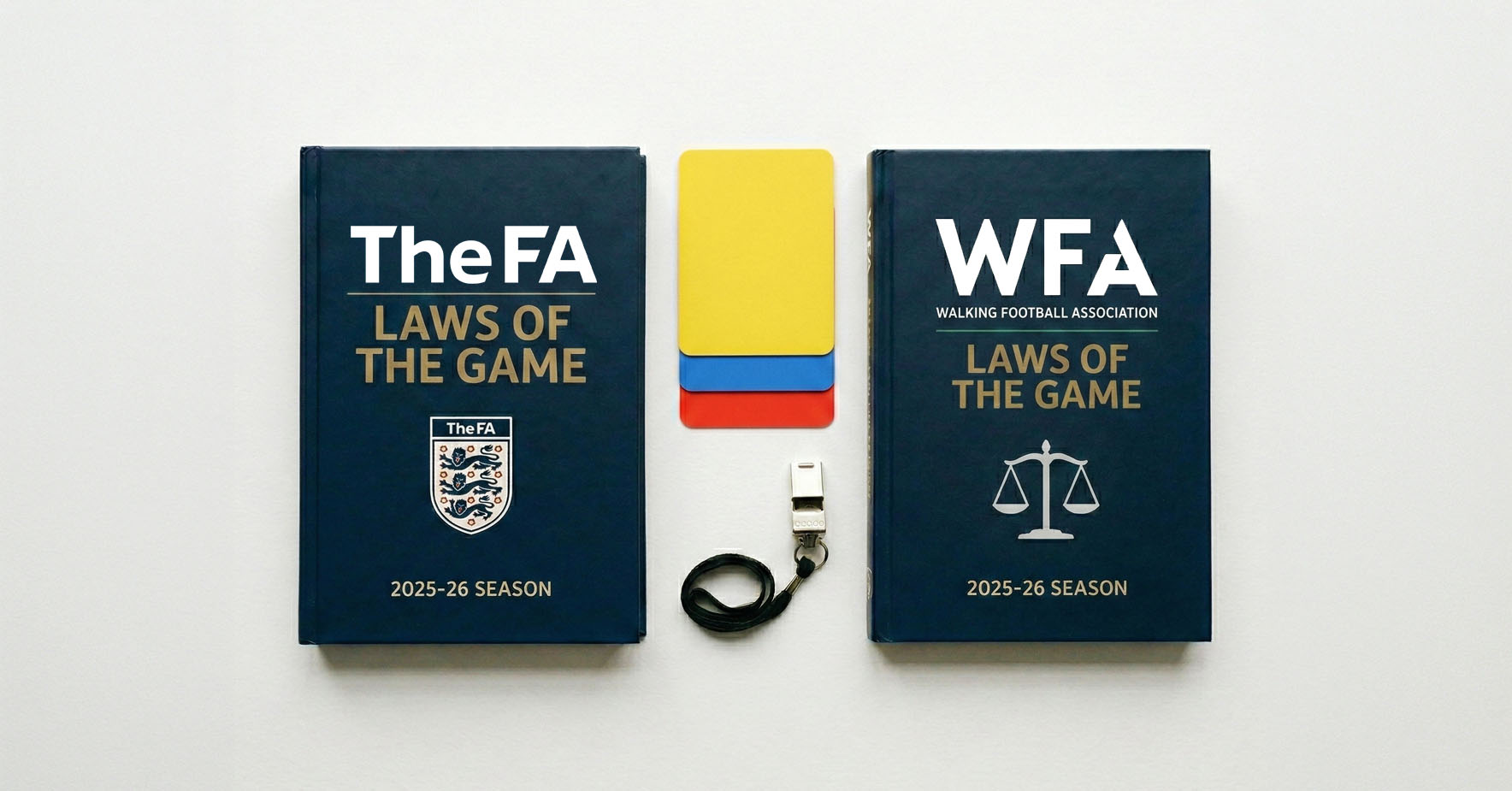
Walking football in England is currently played under two distinct sets of rules: one published by The FA and one by the Walking Football Association (WFA).
For players, referees and clubs, understanding the which ruleset an event abides by can be both confusing and a genuine barrier to entry.
In early 2025, The FA and WFA launched a joint consultation on unifying their Laws of the Game, marking a historic first step toward a single national standard and step closer to this guide becoming obsolete!
Incredibly, after a decade of two rule books, nobody has ever published a comprehensive comparison of their differences. Until now.
Below you’ll find a rule-by-rule breakdown of every meaningful difference between the two codes, drawn directly from the official 2025/26 editions of both documents: The FA Walking Football Laws of the Game (February 2025) and the WFA Laws of the Game (April 2025).
Rule comparison
1. Pitch Dimensions
| Format | FA | WFA |
|---|---|---|
| 5/6-a-side length | 25m–50m | 35m–45m |
| 5/6-a-side width | 16m–35m | 25m–37m |
| 7-a-side length | 50m–60m | Not specified separately |
| 7-a-side width | 30m–40m | Not specified separately |
The FA allows considerably more flexibility on pitch size, reflecting the reality that many venues cannot meet exact specifications. The WFA’s ranges are tighter, although the WFA does acknowledge that pitches falling outside their guidelines can still be used at the referee’s discretion.
2. Goal Area
| Rule | FA | WFA |
|---|---|---|
| Shape | Semi-circle | Semi-circle |
| Radius | Fixed 6m | 4m–6m (flexible) |
| Penalty mark | Fixed 6.5m from goal centre | 6m–7m from goal centre |
Both codes use a semi-circle, but the WFA provides more flexibility on radius and penalty mark distance. In practice, the WFA’s maximum of 6m often mirrors the FA’s fixed 6m, but the flexibility matters for venues with non-standard markings.
3. Barriers
| Rule | FA | WFA |
|---|---|---|
| Permitted? | Yes, but without barriers recommended | Yes – acceptable for club games |
| Tournaments/cups | No restriction stated | Not permitted by default. Written permission required |
| Ball hitting barrier | Ball stays in play | Ball is dead – restarted accordingly |
This is one of the most significant practical differences. Under FA rules, the ball remains in play off a barrier, whereas under WFA rules it is immediately dead. This fundamentally changes the flow and tactics of the game and is likely to be one of the most contested points in any unification discussion.
4. Walking – Definition and Sanctions
| Rule | FA | WFA |
|---|---|---|
| Definition | At least one foot in contact with the ground at all times | One foot in contact with ground, both feet momentarily grounded with advancing leg straightened |
| Goalkeeper exemption | Yes – exempt when making a save (diving/jumping) | No specific exemption stated |
| Individual sanction | Indirect free kick | Indirect free kick, red card possible if DOGSO applies |
| Team accumulation rule | Yes – 4th team offence = penalty kick, count resets | No team accumulation rule |
The FA’s team accumulation rule, where a fourth collective “not walking” offence by a team concedes a penalty kick, is a notable innovation with no WFA equivalent. And you can bet it catches out a lot of players crossing over from FA sessions.
It’s designed to discourage teams from tactically accepting individual free kicks while collectively pushing the pace. The WFA’s more detailed walking definition (specifically mentioning the advancing leg straightening) gives referees a clearer physical benchmark.
DOGSO: Denial of an Obvious Goal-Scoring Opportunity
5. Ball Height Restriction
| Rule | FA | WFA |
|---|---|---|
| Maximum height | Not less than crossbar height, not greater than 2m (set by competition) | 1.83m (head height) or crossbar height |
| Standard sanction | Indirect free kick from where offence occurred | Indirect free kick, ball deemed dead |
| Goalkeeper save exceeds height | Kick-in or roll-in to opposing team | Ball retained by goalkeeper (various exceptions) |
| Ball deflects off goalkeeper above height | Kick-in or roll-in to opposing team | Ball retained by goalkeeper (with specific exceptions for goals and out-of-play) |
| Ball deflects off goal frame above height | Not specifically addressed | Not a foul, ball deemed dead, retained by goalkeeper |
The WFA rules on height are considerably more detailed than the FA’s, with multiple sub-clauses covering deflections off the goalkeeper, goal frame and barriers.
The FA’s approach is simpler and arguably easier for referees to apply consistently. The WFA’s nuanced exception allows a goal if a save deflects above head height and drops into the net.
6. Physical Contact
| Rule | FA | WFA |
|---|---|---|
| Contact permitted? | No | No |
| Specific definitions | Charges, jumps at, kicks, pushes, strikes, tackles, trips | All of the above, plus tackling across a barrier, blocking/cornering against a barrier, crowding against a barrier, shoulder charging, stepping across/obstructing |
| Tackling from behind | Not specifically addressed | Expressly prohibited, regardless of contact |
The WFA provides more specific definitions, particularly around barrier-related contact. The explicit prohibition on tackling from behind, regardless of whether contact is made, is a WFA-only provision. Both codes share the same intent, but the WFA’s greater specificity may make it easier to referee consistently.
7. Heading
| Rule | FA | WFA |
|---|---|---|
| Outfield players | Prohibited – indirect free kick | Prohibited – indirect free kick |
| Goalkeeper heading to prevent a goal | Not specifically addressed | DOGSO offence – red card and penalty |
| Goalkeeper heading (ball not going toward own goal) | Not specifically addressed | Indirect free kick 3m outside goal area |
The WFA has detailed specific rules around goalkeeper heading that the FA code does not address. The DOGSO provision for a goalkeeper deliberately heading to prevent a goal is a significant sanction (a red card plus a penalty) that referees using WFA rules need to understand well.
8. Free Kicks
| Rule | FA | WFA |
|---|---|---|
| Type | All indirect | All indirect |
| Opponents’ distance | At least 3m | At least 3m |
| Kicker’s approach | Both feet on ground, no more than 2m from ball | Maximum 1m run-up, unlimited walking steps toward ball; must be stationary before approach |
| Quick free kicks | Not specifically addressed | Permitted without referee signal if deemed safe |
| Goal via deflection only | Not specifically addressed | Disallowed – must be actively played by another player; a simple deflection is not sufficient |
| Goal from kick-off | Not permitted, goal kick awarded to opponents | Not permitted, free kick awarded to opponents |
The WFA’s “actively played” condition for a goal from a free kick is a meaningful difference affecting attacking set-piece strategy considerably. The WFA’s tighter approach requirement (1m vs the FA’s 2m) also changes how free kicks feel in practice.
9. Penalty Kicks
| Rule | FA | WFA |
|---|---|---|
| Direct goal permitted? | Yes | Yes |
| Goalkeeper position | At least part of one foot on or in line with goal line | Both feet on goal line until ball is in play |
| Kicker’s approach | Both feet on ground, no more than 2m from ball | Maximum 1m run-up, unlimited walking steps |
| Feinting | Feinting during approach permitted; feinting after approach completed = blue card | Simulating striking to cause goalkeeper to move = foul |
| Other players’ position | At least 3m from ball, behind or to side of mark, outside penalty area | At least 2m from ball; behind the ball |
| Backheels permitted? | Not addressed | Yes, provided ball moves forward |
The WFA’s stricter goalkeeper position rule (both feet on the line rather than just part of one foot) and its explicit permission for backheeled penalties are two notable distinctions. The difference in approach distance (2m vs 1m) mirrors the free kick difference.
10. Corner Kicks
| Rule | FA | WFA |
|---|---|---|
| Direct goal permitted? | Yes – against opposing team only | No – must be played by another player first |
| With barriers (no corner possible) | Goal clearance by goalkeeper in that half | Goal kick awarded |
A direct goal from a corner is permitted under FA rules but not WFA rules – a clear and potentially match-deciding difference that players moving between the two codes need to know.
11. Kick-ins
| Rule | FA | WFA |
|---|---|---|
| Roll-in permitted? | Yes – underarm action required | Not specified as an option |
| Approach to ball | Part of each foot on or outside touchline | 1m maximum run-up, taken from behind touchline |
| With barriers | No kick-ins, goal clearance by goalkeeper in that half | No kick-ins, goal kick awarded |
| Goalkeeper taking a kick-in | Not specifically addressed | Expressly prohibited, kick-in reversed and totting-up warning issued |
12. Goalkeepers
| Rule | FA | WFA |
|---|---|---|
| Ball distribution | Underarm throw or kick from ground | Below-waist underarm roll or kick from ground, drop kick volleys not permitted |
| 6-second rule | Yes – cannot hold ball or allow it to stop for more than 6 seconds | Not specified |
| Back passes | Cannot receive back pass directly from team-mate after passing to them | Unlimited back passes permitted, time-wasting at referee’s discretion |
| Leaving penalty area | Penalty to opposing team | Penalty to opposing team (momentum exception applies) |
| Scoring a goal | Disallowed, goal clearance awarded | Disallowed, ball retained by opposing goalkeeper |
| Goalkeeper scoring in penalty shootout | Permitted | Not separately addressed |
The FA’s 6-second rule and back pass restriction are significant additions that the WFA laws do not include. In practice, the absence of a 6-second rule in WFA games can allow a goalkeeper to hold possession much longer and disrupt the tempo of play.
13. Substitutions
| Rule | FA | WFA |
|---|---|---|
| Rolling substitutes | Only if a second official is present, otherwise during stoppages only | Always rolling – during any suitable stoppage, with referee permission |
| Player re-entry | Substituted player may return to the field | Not specified |
| Minimum players to continue | 5-a-side: Three 6-a-side: Four 7-a-side: Four |
5-a-side: Three 6-a-side: Four 7-a-side: Four |
The WFA’s default of always-rolling substitutes is a preference for many recreational sessions, removing the need for a second official to manage subs fluidly. The FA’s approach reflects a more formal match environment.
14. Disciplinary – Sin Bin (Blue Card)
| Rule | FA | WFA |
|---|---|---|
| Sin bin duration | Set by competition – between 2 and 5 minutes | 10% of total game duration (e.g. 2 mins in 20-min game, 6 mins in 60-min game) |
| Trigger mechanism | Category-based (C1–C9 cautionable offences) | Explicit 3-infringement totting-up system |
| Second blue card | Results in red card | Results in red card |
| DOGSO + penalty | Blue card if offence was an attempt to play the ball | Blue card if offence was an attempt to play the ball |
| Yellow card alternative | Yes – where sin bin area not practicable (e.g. enclosed sports hall) | Not addressed |
The WFA’s explicit 3-infringement totting-up system creates a clear escalation pathway, whereas the FA’s category-based approach gives referees more discretion. The FA’s yellow card alternative provision for enclosed venues is a useful accommodation not found in the WFA code.
15. Equipment and Safety
| Rule | FA | WFA |
|---|---|---|
| Jewellery | All jewellery forbidden, plain wedding bands that cannot be removed may be covered | Jewellery must not be openly worn, tape may cover rings |
| Shin pads | Compulsory, covered by socks | Compulsory, covered by socks (medical dispensation allowed) |
| Spectacles | Sports spectacles permitted | Sports goggles with prescription lenses advised, players responsible for type worn |
| Protective equipment | Non-dangerous headgear, facemasks, knee/arm protectors permitted | Not specifically addressed |
What the rules mean in practice: A WFW View
It’s highly unlikely any player is going to choose one set of rules over another due a few minor differences, but as the gap widens, there are almost certainly better laws to follow for different types of players.
At Walking Football World, we clearly define which set of rules every event listed on our site follows, and even allow you to filter your search accordingly.
Here are some general guidelines we’ve prepared for those looking for more clarity.
For new players and recreational sessions 
The FA ruleset is arguably more accessible for newcomers to the sport due to its similarities – for better or worse – to small-sided football.
Its simpler height restriction rules and clearer walking definition make the game slightly easier to play and referee without specialist knowledge, but there are also a number of points left unaddressed compared to the WFA.
The FA’s team accumulation rule for walking offences also naturally discourages teams drifting into running without needing to single out individuals repeatedly.
For competitive and structured league play 
The WFA’s greater specificity, particularly around contact, tackling angles, heading by goalkeepers, and the totting-up system, provides more tools for referees to manage the physical sides of a game.
Experienced players who know the rules well tend to appreciate the precision the WFA laws offer. Plus, the WFA’s stricter approach to barriers in cup competitions also reflects a genuine safety consideration at higher levels.
For older or more cautious players 
The WFA actively reassures players concerned about physical risk by explicitly banning tackles from behind (even without contact), enforcing strict barrier-contact rules and taking a highly conservative approach to foul play.
Meanwhile, the FA champions player safety at all levels by sensibly exempting goalkeepers from the walking rule when they make saves.
For referees
The FA ruleset is generally simpler to administer, particularly for referees new to the format. The WFA’s 15 sub-sections on ball height alone, while thorough, place a considerable knowledge burden on officials.
The FA’s team walking count is an interesting concept that shifts some responsibility for managing pace away from individuals.
Potential unification sticking points
The ongoing FA/WFA consultation on a unified ruleset is a positive development, but based on the differences listed above, it’s possible that some rules will be significantly harder to reconcile than others.
Barriers: Probably the single biggest obstacle. The WFA position of “ball dead on contact with barrier” directly conflicts with the FA’s fundamentally different view of the ball remaining “live”. Whole tactical styles and session formats are built around each approach. A compromise here will inevitably disappoint someone.
The definition of walking: The WFA’s more technical definition (advancing leg straightened) versus the FA’s simpler one-foot-on-the-ground standard may seem like a minor point, but inconsistent application of the walking rule is already one of the most common sources of frustration in walking football. Getting this right in a single unified rule book really matters.
The team walking accumulation rule: The FA’s fourth-offence penalty is an interesting concept, but clubs and leagues that have operated without it for years may resist the change. Equally, WFA clubs may not welcome a rule that can concede a penalty for accumulated minor offences rather than a single clear foul.
Goalkeeper rules: The FA’s six-second rule and back pass restriction, versus the WFA’s more permissive approach, reflect different philosophies about game tempo. Recreational players accustomed to WFA games often use the goalkeeper as a safe outlet to control pace. Introducing time pressure on the keeper changes that.
The “actively played” free kick rule: The WFA’s requirement that a goal from a free kick must be actively played by another player and not simply deflected is a nuanced judgement that requires consistent refereeing.
Direct goals from corners: Permitted under FA rules, but not permitted under WFA rules. The simple solution would simply be to pick one approach and commit to it.
What next for walking football rules?
The differences between the FA and WFA codes are real, meaningful and in some cases fundamental to how the game is experienced.
If you haven’t yet responded to the joint survey, you can have your say on a single rule book here. The consultation is open to players, clubs, leagues and referees, providing an opportunity for you to shape the future of the sport’s rules at national level.
Walking Football World is the UK’s leading directory of walking football venues and sessions, listing clubs that play under both FA and WFA rules. Find walking football near you now.